In today's digital world, simple product images are no longer enough to convince discerning customers - especially not in an industry such as the jewellery industry, which is all about aesthetics, emotion and fine details. This is exactly where real-time 3D web integration comes into play - a technology that is currently in the process of changing e-commerce for good.
A look back: from product photos to photorealistic rendering
Online retail has developed significantly in recent years. Particularly in the premium and luxury segment, static product photos have increasingly been replaced by photorealistic 3D renderings. Today, many companies already use computer-generated images (CGI) to present their products in a high-quality and flexible way - often more beautifully than photos ever could.
These renderings make it possible to show variants of a product that may not even physically exist yet. They save costs, shorten development times and offer a standardised visual experience. But as realistic as they look, they remain static. The customer cannot experience the product interactively.
This is exactly where the next big step comes in: interactive visualisation in real-time 3D directly in the browser.
The new standard: Interactive real-time 3D experiences
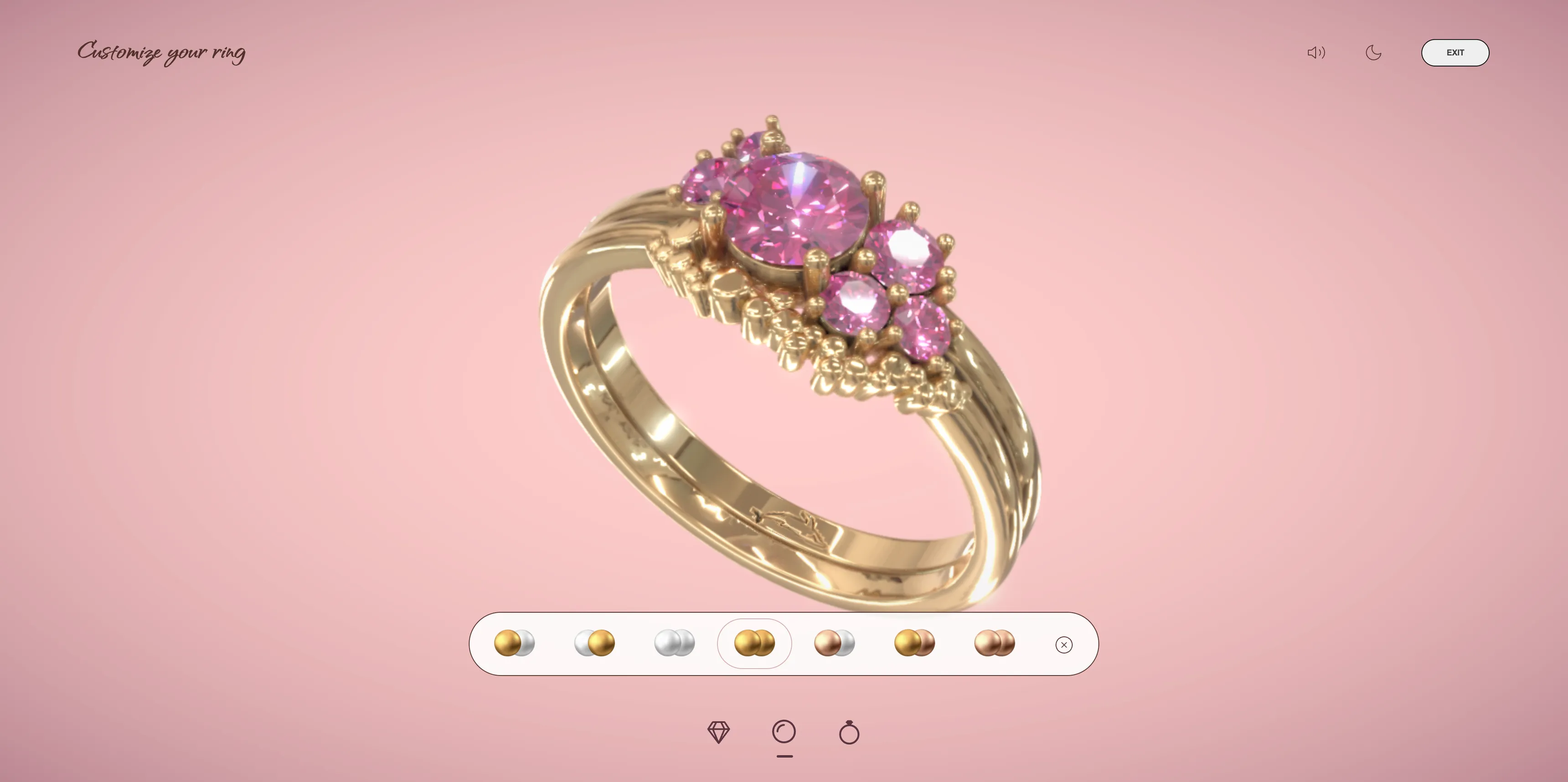
With modern technologies such as Three.js, WebGL or Babylon.js, high-quality 3D models can now be displayed directly in the web browser - without any plugins or additional software. The website threejs-jewelry.vercel.app impressively demonstrates what this can look like in practice: Users can rotate and zoom a piece of jewellery, view it from different angles and even configure it live.
The special thing about this is that the visualisation is not pre-rendered, but calculated in real time. Changes to material, colour or shape are displayed immediately and smoothly in the browser - and create a new, convincing user experience.
Why jewellery in particular?
Jewellery is a very emotional product. It stands for style, memory, status or affection - the selection process is correspondingly careful. The decision in favour of a particular piece depends largely on how well the customer can imagine the product.
Real-time 3D web integration offers exactly that:
- A realistic and detailed representation of the jewellery in different materials and variations.
- The ability to view and rotate pieces of jewellery from all perspectives.
- Live configuration of precious metals, gemstones, engravings or sizes - with no waiting time.
- A more precise assessment of proportions, colours and surface effects.
All of this promotes confidence in the product and makes the purchase decision easier and more secure.
A trend with a tailwind: where the internet is heading
Major brands such as Apple are already showing where the journey is heading. When introducing new devices - such as the MacBook Pro or the Apple Vision Pro - the company consistently relies on 3D elements, animations and interactive product presentations on its websites. These experiences are no longer just visual highlights, but an integral part of brand communication.
What used to be considered a ‘gimmick’ is increasingly becoming the standard. The reasons are obvious:
- Browser technology is mature and powerful.
- Mobile devices can now also display 3D content smoothly.
- Customers expect interactivity and an immersive shopping experience.
E-commerce is evolving away from traditional shop pages towards experience-orientated, visually shaped sales platforms.
Advantages for brands and retailers
The integration of real-time 3D not only offers a better shopping experience, but also strategic advantages:
- Higher conversion rates: customers are more likely to buy if they can realistically experience the product.
- Reduced return rates: Better visual information reduces the number of failed purchases.
- Competitive advantage: Innovative brands clearly stand out from the standard.
- More personalisation options: Configurators enable individual jewellery designs.
- Scalability: Once developed, 3D models can be used for e-commerce, social media, AR applications and point-of-sale.
Conclusion: Invest now and you'll be ahead tomorrow
Real-time 3D web integration is not a short-term trend - it is a milestone in the development of digital commerce. This technology really comes into its own in the jewellery sector in particular, where products are rich in detail, individual and emotionally charged.
Brands that invest in 3D experiences today not only set an example for innovation, but also create a connection with the customer that goes far beyond the classic online purchase. They offer an experience that inspires, convinces - and sells.